


If you grow wheat or corn, you already know the rhythm: watch the crop, watch the moisture, harvest when it's time, and get it in the bin. What happens next is where too many operations leave money on the table.
Right now that rhythm is playing out differently depending on where you farm. Across the Deep South, a lot of producers have already wrapped up wheat and have their eyes on corn. Further north and west, wheat is coming off now or will be within a few weeks. Wherever you fall in that window — and whatever you're putting in the bin — the protection plan is the same.
Stored grain is a depreciating asset the moment it leaves the field — unless you actively protect it. Insects don't wait for you to make a plan. They're already in the bin, already in the grain, already reproducing. And this year, they have a head start.
Why 2026 Is Different
NOAA data confirmed that winter 2025-2026 was the second warmest in 131 years. Across much of the grain belt, the sustained cold that producers count on to naturally suppress insect populations simply didn't happen. That means the biological clock on stored grain insects never reset this winter. Populations heading into this harvest — wheat now, corn this fall — are higher than normal, and the timeline from "clean grain" to "infested grain" is compressed.
The cold kill most producers counted on never came. If you're planning to store wheat or corn this year without active protection, insect populations already have a head start you can't afford to ignore.
This isn't a scare tactic — it's math. Warmer winters mean more surviving adults going into spring, which means faster population growth once grain goes into warm bins. The producers who treat at harvest will be fine. The ones who wait and watch will be calling for a rescue treatment within weeks, or worse, facing grade discounts and rejected loads at the elevator.
The Two Approaches to Grain Protection
At Real McCoy, we offer two fundamentally different ways to protect stored grain. Understanding the difference helps you decide what fits your operation and budget.
Approach 1: Grain Protectants (Chemistry)
This is the most common and cost-effective approach. A grain protectant is applied directly to the grain stream as it goes into the bin. It provides residual insect control from day one — killing adults on contact, disrupting reproduction, and maintaining a protective barrier throughout storage.
Our flagship product, Gravista, is a 3-in-1 formulation that combines an adulticide, an insect growth regulator (IGR), and a synergist in a single application. That means you get immediate knockdown, long-term reproductive disruption, and enhanced efficacy — all without needing a pesticide applicator's license.
Why does the "no license" part matter?
Traditional fumigants like Phostoxin (aluminum phosphide) are restricted-use products that require a certified applicator. That means hiring someone, scheduling around their availability, sealing the bin, and waiting days for re-entry. Gravista and Centynal SI are general-use products. You and your team can apply them directly, on your schedule, the day grain goes in.
Centynal SI works in two situations. If you already have an active infestation, it delivers fast knockdown of existing bugs without the cost, downtime, or safety concerns of fumigation — that's your rescue treatment. It's also the right choice when you're only storing grain for a few months and don't need extended residual protection. For longer-term storage, Gravista is the prevention play.
How long does the residual last? That depends on conditions — grain temperature, moisture, commodity type, and storage environment all factor in.
If you're in south Texas or another high-pressure region
Central Life Sciences recommends a fortified protocol: add 9 oz of Centynal EC and 20 oz of PBO-8 per 1,000 bushels to your Gravista application. This brings deltamethrin to 1 ppm for stronger front-end knockdown in areas where insect populations never fully reset. Call us at 1-844-REAL-GRAIN if you're not sure whether your area qualifies.
Approach 2: Grain Cooling (Physics)
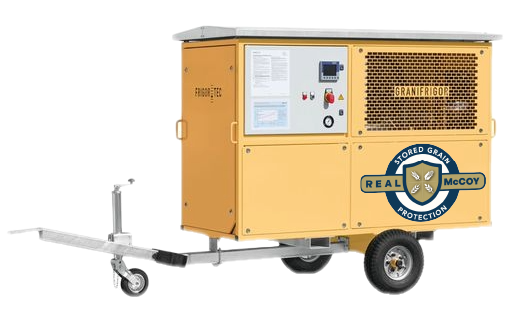
The Granifrigor takes a completely different approach. Instead of chemistry, it uses temperature. The unit — manufactured by FrigorTec, now in its 5th generation and used in over 100 countries — pushes refrigerated, humidity-controlled air through your grain mass, dropping the temperature to 50°F regardless of ambient weather.
At that temperature, every major stored grain insect species enters dormancy. No feeding, no reproduction, no damage. Not dead — dormant. As long as the grain stays cool, the insects stay inactive.
The Granifrigor also includes a built-in humidity control system (HYGROMAT) that automatically matches the cooled air to your grain's equilibrium moisture, so it cools without over-drying or rewetting. It works in any climate — rain, fog, 100-degree heat — because it conditions the air before pushing it through the grain, unlike natural aeration which depends entirely on weather.
For organic operations, the Granifrigor is often the only viable option for long-term stored grain protection. No chemicals means no certification conflict.
Key things to know about the Granifrigor
- Initial cooling takes 1 to 3 weeks depending on unit size, bin size, grain type, and storage configuration
- Once cooled, grain naturally retains temperature for an extended period — duration depends on storage type, insulation, and climate
- No pesticide applicator's license required — it's a physical process, not a chemical treatment
- Most operations see ROI in 1 to 2 years from eliminated chemical costs, avoided fumigation fees, reduced drying energy, and prevented grain losses
- Works with flat storage, warehouses, upright silos, and standard bins
Important: if the Granifrigor is on your radar for this harvest, start the conversation now. Every installation begins with a site assessment — storage type, grain volumes, climate zone, operational goals — and then sizing, ordering, and installation follow from there. That process takes time, and right now demand is high.
Granifrigor inventory is tight — and moving fast
Interest in the Granifrigor this season has been strong, and our available units are limited. If you want one in place to protect your wheat or corn, you need to move quickly — we can't guarantee a unit will be available if you wait. Call 1-844-REAL-GRAIN today to check current availability and get your site assessment started before the units we have are spoken for.
What These Products Replace
If you've been using any of the following, our solutions offer meaningful advantages:
Actellic
Single active ingredient, no IGR, shorter residual, growing resistance concerns.
Gravista
3-in-1 formula (adulticide + IGR + synergist). Breaks reproduction cycle. Extended residual. No license.
Phostoxin / Fumigation
Requires certified applicator, sealed bin, days of downtime, zero residual, safety risks, growing phosphine resistance.
Centynal SI
Fast knockdown, no applicator license, no sealed bin, no downtime. Months of residual. Safer alternative.
Malathion
Single mode of action, widespread resistance, shorter residual, organophosphate concerns.
Gravista
Multiple modes of action, resistance development far less likely, longer residual, no license required.
Diatomaceous Earth
Slow-acting, inconsistent in humidity, clogs equipment, dust problems during handling.
Gravista / Centynal SI
Fast knockdown, works in any humidity, liquid application, no dust or equipment wear.
Tools to Help You Plan
We've built several free tools to help you get specific answers for your operation — not generic estimates.
| Tool | What It Does |
|---|---|
| Application Calculator | Calculates exactly how much Gravista or Centynal SI you need based on your bin size and bushels. Found under Resources > Quick Reference Guides. |
| Cooling Time Calculator | Estimates how fast a Granifrigor will cool your specific storage to target temperature. |
| ROI Calculator | Shows the financial return on a Granifrigor investment based on your volumes and current costs. |
| Technical Questionnaire | Generates a customized Granifrigor recommendation — right model, sizing, and configuration. |
For quick reference on standard application rates:
- Grain stream treatment: 3-5 gallons of solution per 1,000 bushels
- Bin spray: 3.5 oz per 1 gallon water per 1,000 sq ft
- Perimeter spray: Same as bin spray rate, applied monthly or bi-monthly
The Bottom Line
Harvest 2026 is here — wheat coming off now, corn close behind — after a winter that did stored grain pests no harm. The operations that treat proactively, at harvest and before there's a problem, will protect their grain, their grades, and their margins. The operations that wait will pay more to fix what could have been prevented for cents per bushel.
Whether you need a protectant, a Granifrigor, or just a conversation about what makes sense for your situation, we're here for it. We've been helping grain operations protect what they've grown for over 25 years. One call, and we'll have a plan — but if a Granifrigor is part of that plan, don't wait, because inventory is limited.
Ready to Build Your Plan?
Order protectant now so it's on-site before the bin fills for wheat or corn. And if you want a Granifrigor this season, call today — inventory is tight and units are going fast.
realmccoy.ag | 1-844-REAL-GRAIN | info@realmccoy.ag