

What does that mean for your stored grain?
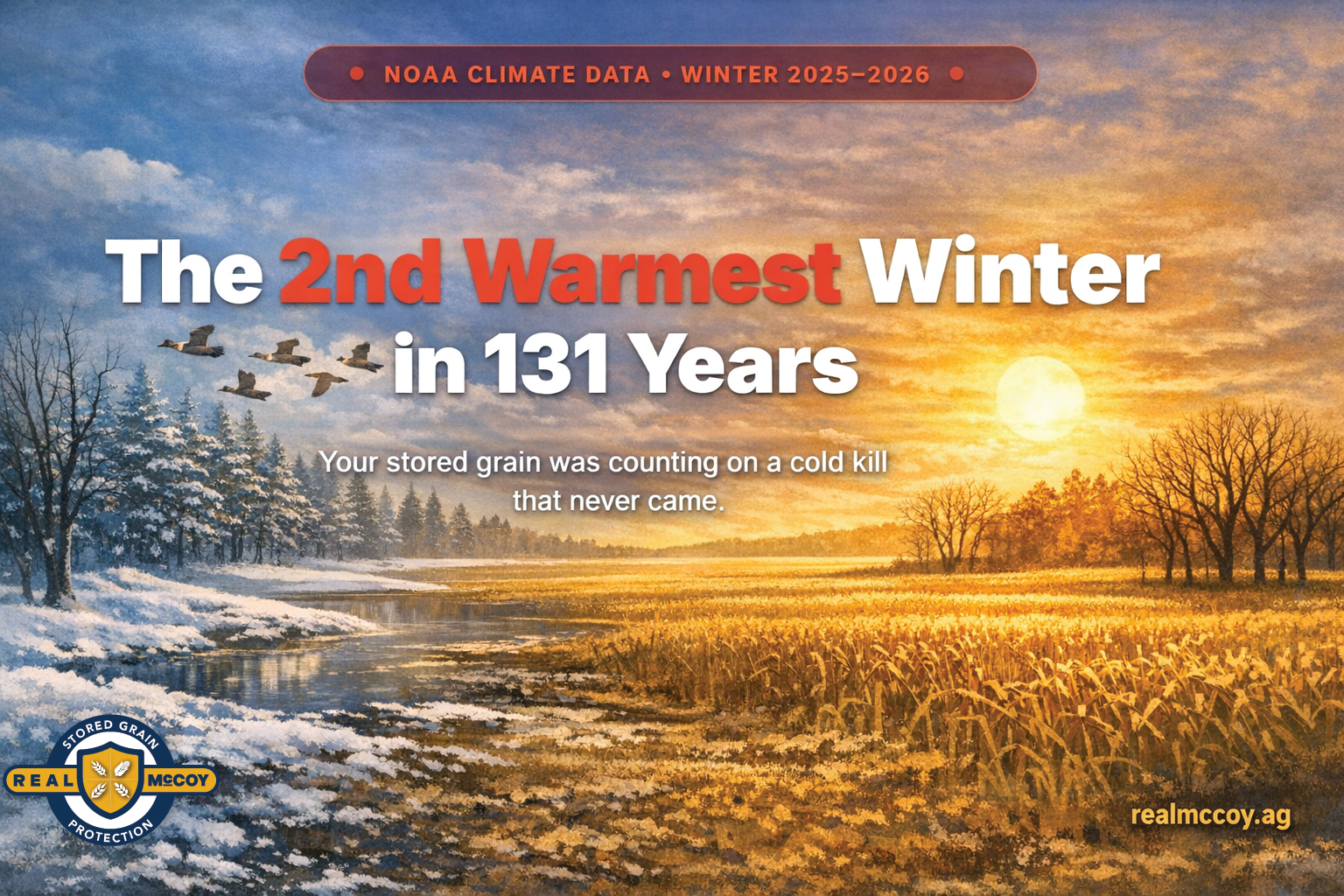
NOAA confirmed it: winter 2025-2026 was the 2nd warmest in 131 years.
For grain in storage across the US, the cold kill most producers counted on never came. If this winter felt mild where you are, you weren’t imagining it. NOAA confirmed in March 2026 that the winter of 2025–2026 was the second-warmest in the 131-year U.S. record — trailing only 2023–2024. The two warmest American winters ever recorded have now occurred back-to-back (NOAA National Centers for Environmental Information, March 2026).
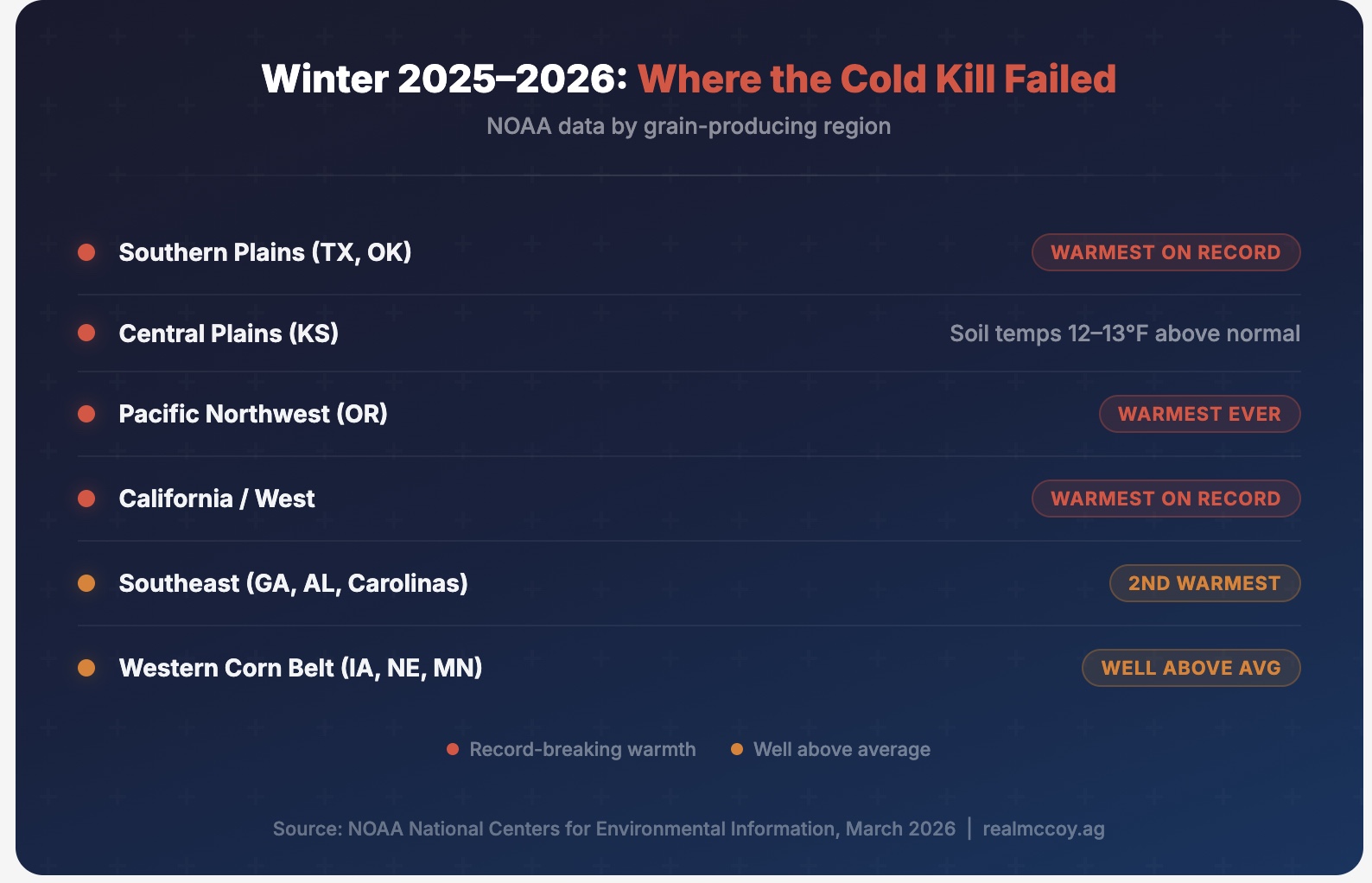
“Nine states broke their all-time warmest winter records. The natural pest suppression that grain producers have relied on for decades is disappearing — and this year, it barely showed up at all.”
What This Means Inside Your Bins
For stored grain, the consequences of a warm winter are biological and they’re compounding right now.
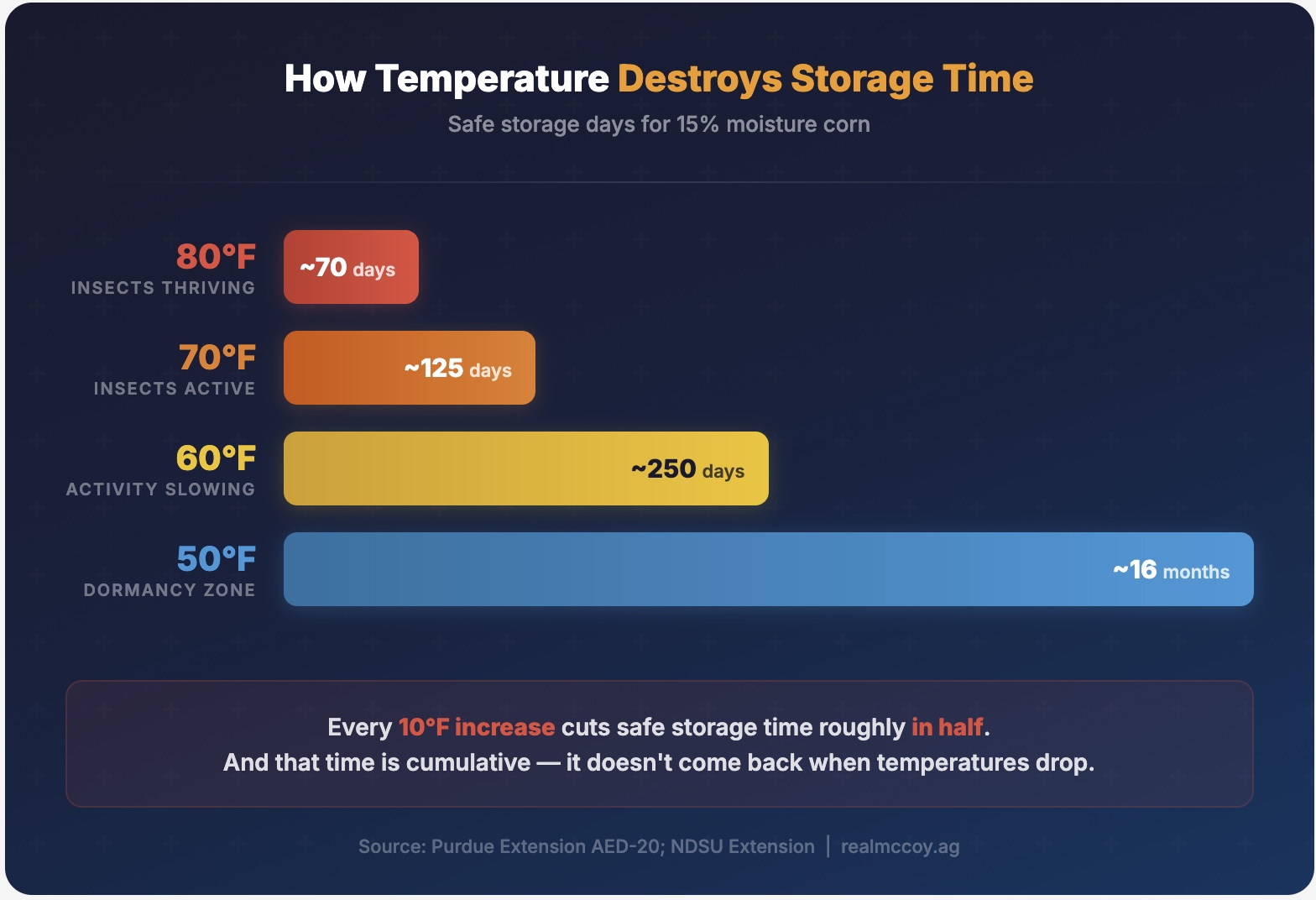
Insects never went dormant. Stored grain pests — rice weevils, lesser grain borers, Indian meal moths, sawtoothed grain beetles — thrive between 70–90°F. Below 60°F, activity drops significantly. Below 50°F, they enter dormancy. In most of the country this winter, bin temperatures spent far more time in the activity zone than the dormancy zone.
A single female rice weevil can produce up to 400 offspring. At 80°F, a full generation cycle completes in roughly 30 days. In a warm winter, you’re not dealing with one generation — you could be looking at three or four generations that would normally never have hatched.
Allowable storage time was consumed faster than expected. Each 10°F increase in grain temperature cuts safe storage time roughly in half. Grain that was expected to hold through spring at normal winter temperatures may have already consumed a significant portion of its storage life — and that time doesn’t come back when temperatures drop (NDSU Extension; Purdue Extension, AED-20).
Moisture migration is accelerating. The brief but severe January cold snap — followed immediately by a return to record warmth — created extreme temperature differentials inside bins. Warm air rises through the grain mass, picks up moisture, and deposits it on cooler grain near the surface and walls. The result: hot spots, surface crusting, and the exact conditions mold and mycotoxins need to thrive.
The damage is invisible until it’s not. Insect populations build in the interior of the grain mass where you can’t see them. By the time you find live insects during sampling or see them at the surface, the infestation is established and quality loss is already locked in.
What This Means for Your Bottom Line
Damaged grain isn’t just a quality dock at the elevator. It’s:
-
- Lost weight. Insect feeding reduces test weight, and you sell grain by the bushel.
- Rejected loads. Elevators with zero-tolerance policies on live insects will turn trucks away. One rejected load costs you more than just the hauling — it can cost you the relationship.
- Mycotoxin risk. Insect activity generates heat and moisture pockets — the exact conditions aflatoxin, fumonisin, and DON need to develop. Mycotoxin contamination can render grain unsaleable at any price.
- Emergency fumigation costs. Fumigation kills insects but doesn’t reverse the damage they’ve already done. And the costs keep climbing — phosphine regulatory requirements are tighter, applicator availability is tighter, and pricing reflects it.
- Possible Missed market windows. Sealed bins during fumigation mean you can’t move grain when the market says move.
U.S. grain producers lose an estimated $4.18 billion annually to post-harvest insect damage — based on the 2025 crop and a conservative 5% loss rate. That figure represents the low end of the commonly cited 5–10% range (USDA ARS; Westside Salvage/USDA estimates).
“$4.18 billion in annual post-harvest losses. And this was the winter where the free pest control most producers count on barely showed up.”
What You Can Do Right Now
If you stored grain last fall and assumed winter would handle pest suppression, the time to act is now — not when you discover a problem in May.
Step 1: Check every bin this week.
Pull samples. Monitor temperatures. Look for live insects, frass, hot spots, musty odors, and surface crusting. The problems you catch now are cheaper to address than the ones you find later.
Step 2: Protect the grain
Apply Centynal SI as a rescue treatment. At this stage, you are in reactive mode if you have not treated your grain. You can use Centynal SI if you can move the grain to another bin or as it gets loaded on a truck. It must sit for 48 hours before being delivered.
No pesticide applicator license is required. These are general-use products. Cents per bushel. Applied once.
Step 3: Take control of temperature.
If your grain needs to hold through spring and summer — and ambient aeration can’t get temperatures where they need to be — mechanical grain cooling with the Granifrigor removes the dependency on weather entirely.
The Granifrigor pushes refrigerated, humidity-controlled air through the bin, dropping grain temperature below 55°F regardless of ambient conditions. At those temperatures, insects enter dormancy, mold growth slows dramatically, and your protectant lasts longer because it’s not working overtime against constant heat.
For organic operations, the Granifrigor is the primary tool — no chemicals involved, fully compatible with organic certification.
Step 4: Build the plan for next season.
The two warmest US winters on record have now occurred in the last three years. This is not an anomaly — it’s a trend. Winter temperatures across the Lower 48 have warmed by 3.95°F over the past 50 years, far exceeding any other season (NOAA NCEI).
A grain protection strategy built for the climate of 2010 doesn’t work in the climate of 2026. Whether you need protectant, grain cooling, or both, the time to plan is before harvest — not after.
Call Real McCoy Enterprises to discuss options. Use Gravista (storing longer than 6 months) or Centynal SI (if storing for less than 6 months) OR consider a Granifrigor for cooling your grain

The Takeaway
Winter has been the silent partner in American grain storage for generations. This year — across most of the country — that partner didn’t show up.
The operations that will protect their grain quality and their margins this season aren’t the ones waiting for the next cold front. They’re the ones who’ve already acted.
At Real McCoy, we help grain operations across the country — wheat, corn, rice, peanuts, milo, sorghum, feed — put proactive protection in place. Protectants that don’t require an applicator license. Grain cooling that works regardless of weather. One team, both solutions, one conversation.
Your grain is your investment. Let’s protect it.
realmccoy.ag | 1-844-REAL-GRAIN | info@realmccoy.ag
References
- NOAA National Centers for Environmental Information. “Assessing U.S. Temperature and Precipitation: February 2026.” March 2026.
- Yale Climate Connections. “We just had the second-warmest winter in U.S. history, despite icy blasts.” March 2026.
- Cabarrus Weekly. “Winter 2025–2026 becomes warmest on record in the western U.S.” March 2026.
- K-State Agronomy eUpdate. “Potential effects of warm winter temperatures on the wheat crop.” February 2026.
- UGA Climate and Agriculture in the Southeast. “2025 was warmer and drier than normal.” January 2026.
- FOX 4 DFW. “Texas heat wave: Hottest winter temperature in US history.” February 2026.
- NASA Earth Observatory. “Extreme January Cold.” January 2026.
- IndexBox. “2026 Plains wheat crop at risk from unseasonably warm winter.” 2026.
- Climate Central. “Fewer Freezing Nights.” 2025.
- NDSU Extension. “Keep Stored Grain Cool, Dry During Summer.”
- Purdue Extension. “Managing Dry Grain in Storage.” AED-20.
- USDA Agricultural Research Service. “Stored Product Insect and Engineering Research.”